
Replacing the Bitterness with “Better”ness
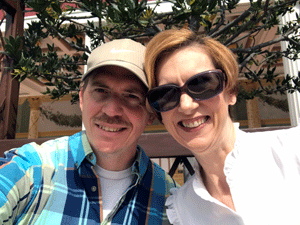
Debra and her husband, Mike, in July 2022
By Debra North, AHA Heart Valve Ambassador
My fourth mitral valve surgery was almost seven months ago now. You got that right: I’ve had not one, not two or even three heart valve surgeries — I’ve had four.
Expecting a fourth surgery was nowhere on my radar after my valve was replaced for the third time in 2017. After a repair that extended my native valve’s “warranty” for almost another 10 years, my tissue valve, which never set in right, was going to be replaced by a mechanical valve. I was assured that problems with mechanical heart valves are rare, so this was supposed to be my last valve replacement.
However, in 2021, I was having issues with my valve sticking. While in the operating room to replace the valve, my surgeon, along with the advice of my cardiologist and two other surgeons at the hospital, decided to cancel the surgery. They discovered that my valve was operating normally so decided there was no reason to move forward with surgery. My surgeon and cardiologist assumed, and rightfully so, that I’d had a tiny blood clot on the valve that had dissolved.
Unfortunately, I did need surgery a year later. It wasn’t a blood clot that had been the culprit after all. I had developed a rare complication — pannus (scar tissue) growth that impeded the function of the mechanical leaflets. I had my mechanical valve replaced, but this time with a larger valve that my surgeon hopes will prevent any scar tissue growth over the leaflets.
Recovery from surgery this time was breezy, and I credit the amazing skill of my highly qualified surgeon with how well I bounced back physically. I spent 10 days in the hospital and another 10 days at home when another complication occurred.
Because I was on a medication at the time that affected the way another medication — Coumadin, an anticoagulant I’ve been on for years back when I simply had atrial fibrillation — worked, my blood became too thin and I developed a frightening gastrointestinal bleed. Because of symptoms, I was rushed to our local emergency department where the emergency room doctor and my cardiologist decided to give me a hefty dose of vitamin K to stop the bleeding, all at the risk of my new valve, not to mention a heart attack or stroke from a potential blood clot. I was beyond scared, and even that is an understatement.
The next day, in the critical care unit (CCU), where my pulmonologist is the head physician, I had an endoscopy to locate the source of the bleed. It turned out I had a stomach ulcer that had been bleeding, and the gastroenterologist clamped off the ulcer. I spent seven days under observation in the CCU being monitored for more bleeding. I was put back on blood thinners slowly and safely, and then moved to the telemetry unit for another two weeks as we waited for my Coumadin levels to be stable.
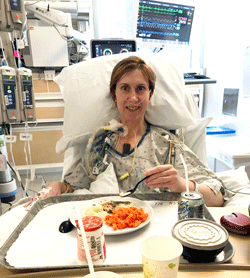
To say that I was traumatized by this experience is again another understatement. I actually had a breakdown in the hospital when one of the doctors mentioned an upcoming discharge for me. I did not want to go home. I wanted to stay in the hospital where I felt safe and monitored.
I did go home, of course, but the trauma remained. Through my health insurance, I worked with a case carrier and social worker to find a therapist to help me process my frightening experience. Although I did not find an appropriate therapist through my insurance, my family physician recommended a therapist to help me. I started meeting with this therapist — a licensed mental health professional — a few weeks ago, and I feel so much better. She has patiently walked me through processing the trauma I experienced, and I can look back at the event without anxiety or fear.
Even in my darkest days sitting in the CCU and wondering whatever other complications might arise along with the fear of bleeding again, I was never bitter. OK, maybe I was, but working with my therapist has helped me replace the bitterness with “better”ness.
I advise anyone who’s been through heart surgery and is struggling with out-of-control emotions to seek the help of a mental health professional. It doesn’t make us weak to ask for help because even acknowledging that we need help is strength in itself.
I’m happy to report that I went back to work in August, which I was looking forward to. I also completed cardiac rehab in mid-October, and I have regained my physical strength and stamina. You should see my biceps now! Most of all, I’ve regained my emotional strength, and that is everything. Better, not bitter.
For more information on this health topic, visit heart.org.
Would you like help dealing with heart or stroke conditions -- either yours or someone else’s? Join us in the AHA’s Support Network! We are an online community of patients, survivors and caregivers where you can share your experience while getting encouragement, hope and informational resources from others who have been there. Membership is free and the benefits can be priceless. Register today.