
Heart Journey Intensifies During Pregnancy, Leads to the Birth of Healthy Baby
By Kacie Nowakowski
I was born with hypertrophic cardiomyopathy, heart murmur, and a VSD. From birth until the age of 17, I had yearly check-ups. I was told that I was "in the clear" at the age of 18, so I stopped having my heart checked.
For the last 13 years, I have been snowboarding in the mid-west, rock climbing out west, managing an ultimate watersports camp in 90+ degree weather while teaching sailing and kayaking, racing mountain bikes for Mid-Atlantic Super Series, coaching gymnastics, and sailing on the Chesapeake Bay – all with intense heart flutters.
In my mid-twenties, I mentioned the heart flutters to my primary care doctor and they were diagnosed as panic attacks. The doctor prescribed me an anxiety medication to cope.
At the age of 30, my husband and I decided it was time to have a child. I was attending an OB appointment in November of 2021. After collecting my family history, they decided to get my heart checked. In December of 2021, I had a cardiac event monitor, which showed palpitations associated with non-sustained ventricular tachycardia, a maximum heart rate of 160 bpm, and supraventricular tachycardia. Post OB appointment, I was labeled a "high risk pregnancy."
I had my first echocardiogram in 13 years on January 20, 2022. After the sonographer finished, he walked me to a meeting room in silence. When the pediatric heart doctor came in to introduce himself, he sighed deeply before sharing the results. He summarized my echo: severe obstructive hypertrophic cardiomyopathy, moderate mid-cavitary left ventricular outflow tract obstruction, hyperdynamic left ventricular systolic function, and mildly impaired left ventricular relaxation.
As he was explaining the severe degree of my heart diagnoses, my palms were sweating as I was trying to swallow my tears and the unsettling feeling I had in my stomach. I began to lose my hearing and my eyes became foggy. The pediatric heart doctor walked out of the meeting room to give me a few minutes to catch my breath. The sonographer popped in to share his deep apologies for the news. Within hours that evening, my pediatric heart doctor reached out to a hypertrophic cardiomyopathy doctor and electrophysiologist on his team. This wonderful team of doctors pushed for appointments for me within the next week.
Following the breaking news, I walked out of the lobby and into the hallway of the facility, bawling my eyes out and trying to find the nearest bench to sit on. As I sat on the bench, hands shaking, I called my husband to share the startling news.
Going into my second trimester and 14 weeks pregnant, my husband and I met with the electrophysiologist. He was quick to bring up the importance of an implantable cardioverter defibrillator (ICD) and recommended a safe-for-pregnancy beta-blocker to slow down the heart. I was given one week to decide between a wearable, subcutaneous, or transvenous ICD.
I read blogs, stories, and medical articles, yet there was nothing to provide insight about ICDs for a pregnant patient. My husband and I weighed tried to weigh the pros and cons of each device and decided on the subcutaneous ICD. While waiting 14 days to hear back from insurance, I researched the web for blogs and patient stories, spoke to hypertrophic cardiomyopathy nonprofit organizations about their opinions, etc. There are not a lot of stories out there on pregnant women who needed an ICD implant, immediately.
On March 24, 2022, I underwent the subcutaneous ICD procedure at 22 weeks pregnant. The ICD placement was on my left side, which is the encouraged side to sleep on while pregnant. I was not allowed to sleep on my back due to pregnancy and could not sleep on my sides due to the ICD implant and pain from the procedure. Thus, I slept sitting up for two months straight.
Fast forward from March to May, my OB and heart team decided that I would have a C-section depending on how my heart held out from week 34 to week 36 of pregnancy. As I was growing our little girl, I had to increase the dose of my beta blocker. During the month of May, I experienced a few shortened heart flutter episodes, seeing stars while sedentary, and fatigue. We performed echocardiograms and stress tests on a weekly basis. I was told that my heart would not survive labor.
On July 28, 2022, I was admitted to hospital to be monitored in the Cardiac ICU and underwent a right heart catheterization procedure. I was then monitored by my OB and heart team in the cardiac ICU for 24 hours. My right heart catheter monitored the pressures in my heart.
On Thursday, July 30, 2022, at 36 weeks pregnant, I had a C-section to meet my little girl, Madelyn. During the C-section, I had ECMO lines placed into my groin in case of severe heart failure and an arterial line slowly and carefully controlled an epidural block. My subcutaneous ICD remained turned on.
During the C-section, I was able to meet Madelyn for 30 seconds as the surgeon brought her over to my face. Post procedure, I experienced a horrible reaction to a medicine which had me delirious for 12 hours while in the cardiac ICU. My husband spent most of his time in the NICU with Madelyn. I was under careful watch by the cardiac nurses.
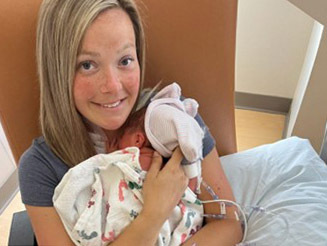
After 24 hours of watch, I was able to finally hold my baby for the first time! The cardiac nurse wheeled me over to the NICU at 11 pm a day later. As I was rolled into the NICU room where Madelyn was hooked up to monitors, IV leads, and feeding tubes. I was silent. Everything in the room became foggy looking at Madelyn as she laid in the incubator. I felt a huge weight lifted from my shoulder, my heart became soft, and my mind felt at ease. It was such a precious gift to be able to hold my newborn.
My husband and I did not sleep for 48 hours due to the loudness in the cardiac ICU and moving to three different floors throughout the night to get into a labor and delivery room. I spent about three days in the labor and delivery room with my husband while going back and forth throughout the day to visit Madelyn in the NICU. We spent countless of hours staring out the hospital windows, reflecting on the last 8-month journey of pregnancy and my heart. Madelyn spent two weeks in the NICU due to feeding challenges, but fortunately, her heart was strong and healthy.
Go Red for Women and Better Starts for All are committed to improving maternal health and empowering all moms like Kacie. Visit GoRedforWomen.org/pregnancy to learn more about the impact of pregnancy on cardiovascular health. Better Starts for All is a proud national supporter of the American Heart Association’s Go Red for Women movement.
Would you like help dealing with heart or stroke conditions -- either yours or someone else’s? Join us in the AHA’s Support Network! We are an online community of patients, survivors and caregivers where you can share your experience while getting encouragement, hope and informational resources from others who have been there. Membership is free and the benefits can be priceless. Register today.