Adapting to Stroke and Its Impact on My Life as a Writer by Joyce Hoffman
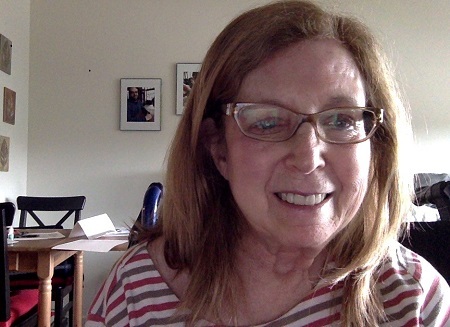
Joyce Hoffman is a writer and stroke survivor. You can find her published books and articles on her websites: https://stroketales.blogspot.com and https://dearjoyceadvice.blogspot.com.
Writing is both my passion and salvation.
In an instant, on April 8, 2009, my world was thrown into the unknown when I suffered from a hemorrhagic stroke. I was employed at an international law firm, in Philadelphia. But that changed when I suffered from the stroke and I was unable to return to the career I had built – even a year after rehabilitation and physical therapy. That first year post-stroke was difficult, to say the least. As I adjusted to my new reality as a stroke survivor, I realized that I was disabled, and my life would never be the same.
Having lived a healthy lifestyle for 61 years, writing, exercising and maintaining a healthy diet, my stroke came as a shock. After feeling pain in my legs that resulted in a horrific headache, I woke up in the hospital to learn from my son that I had been unconscious for eight days and suffered a hemorrhagic stroke. It took five weeks to regain my speech, and during that time I also learned that the stroke left me with a paralyzed hand and double vision, among other consequences.
As a writer, the impact the stroke had on my core writing and reading faculties left me reeling. And it has been an unpredictable journey of discovery ever since.
In 2010, a year after my stroke, I found myself ordering from a menu that I could barely see. I was meeting a friend at a local vegetarian restaurant and all too soon my anxiety kicked in as soon as I saw the menu handed to me by the server. Though the lighting wasn't dim, the text of the menu items was too small to read and my double vision (which is exacerbated by fatigue) made for impossible reading. I was embarrassed and I didn’t want to ask the server to read the menu to me. So I ended up ordering, “That dish with tofu.” In a vegetarian restaurant, you can imagine how that sounded!
Very quickly it became clear to me that I needed support. I participated in a clinical trial in Kentucky that was designed to see if my hand, which was totally paralyzed, could move with electrical impulses. And it did move! For six weeks, I enjoyed seeing my hand come alive. But when I returned home, the electrical impulses weren't there anymore.
Although the trial did not result in the permanent fix I hoped for, it opened my eyes to the world of technologies that have been developed specifically to alleviate some of the after-effects of a stroke. Upon finishing rehab, I still found myself with a cramped hand, and I knew that my return to writing would be a challenge. While I never thought I would explore the world of assistive technologies for stroke survivors, I have been amazed by what is now available to those of us traversing the recovery path following a stroke.
One of the major impacts of my stroke was seeing double. As an avid reader, this double vision was devastating, taking away my ability to read the way I used to. I began to explore tools and technologies that could help me return to my favorite pastime, as many stroke survivors do. Among them, I found out about a handheld, wireless device that can read any text from a printed page or even a phone or computer screen. I received a device as a loan and had a remarkable experience. The device allowed me to access text again with ease. By just clicking a button, the device would begin reading entire pages of text to me. This would have been just what I needed to read that vegetarian menu all those months ago!
Since my experience with the device, I have come to learn about novel technologies specifically created to support those living with the aftermath of stroke, easing the recovery process, or providing ongoing support for certain post-stroke effects that are irreversible.
With the advent of current therapies and pioneering technologies, I have been able to again enjoy one of my core passions, and for that, I am grateful. Writing has become a healing exercise for me, helping me process the difficulties along the road of recovery, such as typing with one hand, rather than two, on the keyboard. Detailing my experience to help others has become my life’s mission, and the focus of my writing has changed to bring new meaning into my life.
Since my stroke, I have published my second book which recounts my recovery experience, and I didn’t stop there! Once I finished rehabilitation, I dedicated my writing to developing two new blogs about my recovery journey to help those in the stroke community find resources that helped me along the way.
Looking back on my life since that fateful day in 2009, I have come to appreciate that which I may have taken for granted. And I continue to be amazed at the innovation being developed to meet the needs of stroke survivors. It is comforting to know that there are people out there who have dedicated themselves and their talents to creating new tools to help people in stroke recovery. As science and medicine advance together with technology, I believe we have only just begun to scratch the surface of the assistive treatment solutions that are possible.