

My PAD Journey
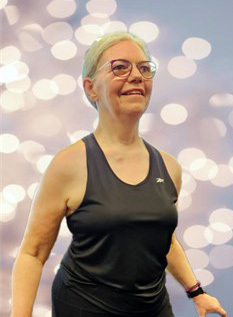
By Mary Bingeman
In the spring of 2021, I went to my family doctor to determine the cause of unusual discoloration on my lower legs that had been there for a few months. I was referred to both a dermatologist and a vascular surgeon. The dermatologist ruled out any possible skin problem. The vascular surgeon told me, “I don’t think there is anything wrong with your circulation, but I will send you for testing to be sure.” An ABI and a Doppler ultrasound revealed an occlusion in my lower left tibial artery. Despite having no pain walking, I was diagnosed with peripheral artery disease (PAD). I had no heart or stroke history and no warning signs leading up to my diagnosis. The specialist told me nothing other than “I will see you in three months for repeat testing.” Even with my background as a nurse, I knew little about PAD. It just isn’t talked about much.
I was really disappointed to learn there were so few support programs for those with PAD. I began a search and was determined to find answers to my question, “What next?” Through a link in a Facebook walking group I belonged to, I found the PAD group I am in now. After joining, I found much more than just support. There is a whole community where actions are encouraged for better health as we all work toward the common goal of living our best life with PAD. The knowledge and resources provided information I never received from my specialists. I felt comforted, understood and motivated to face the challenges I was having.
It was in this group that I learned that walking could build collateral arteries and that dietary selections could impact the severity of PAD. I began to make healthier lifestyle, and I set a daily goal of 8,000 steps, which I reached most of the time through either the treadmill, park strolls or mall walking. I joined a gym and used rowers, ellipticals and assault bikes. I attended dance classes, drum cardio classes and did strength training. I used the pool for water walking, gentle mobility/flexibility and recovery. I changed my diet to low fat/sodium/sugar and began to read labels more. I purposely chose healthier food options while grocery shopping. These changes were initially hard to incorporate but with consistency I got used to them. I finally had hope for a better life.
Now, four years later, I feel very confident I will live my best life with PAD, having made these lifestyle choices. They have become part of my everyday routine. My last testing showed definite collateral formation, multiphasic waveforms throughout, minuscule progression, normal labs, surprisingly, no occlusion. Physically, I feel very good. I have entered a 5K walk to try alongside my daughter this year. I would not even have attempted this four years ago and am very excited to see how I do.
I have a rather serious surgery slated later this year. It is not PAD-related but will sideline my walking for a bit. I have no question that my fellow PAD Warriors from the FB community will be there to cheer and support me through both the surgery and recovery until I am back walking again. Although we cannot do without doctors, it is also true that we absolutely cannot do without the comfort we receive from a community that understands what we are feeling and allows us to become vulnerable with our fears.
Everyone’s journey with PAD will look different, but my best advice is that with commitment, perseverance and consistency you can live your best life. Find something you enjoy doing in order to keep moving.
WE CANNOT ALWAYS CHOOSE THE MUSIC LIFE PLAYS, BUT WE CAN CHOOSE HOW WE DANCE TO IT!
HEALTH CARE DISCLAIMER: This site and its services do not constitute the practice of medical advice, diagnosis or treatment. Always talk to your health care provider for diagnosis and treatment, including your specific medical needs. If you have or suspect that you have a medical problem or condition, please contact a qualified health care professional immediately. If you are in the United States and experiencing a medical emergency, call 911 or call for emergency medical help immediately.
For more information on this health topic, visit heart.org.
Would you like help dealing with heart or stroke conditions -- either yours or someone else’s? Join us in the AHA’s Support Network! We are an online community of patients, survivors and caregivers where you can share your experience while getting encouragement, hope and informational resources from others who have been there. Membership is free and the benefits can be priceless. Register today.